
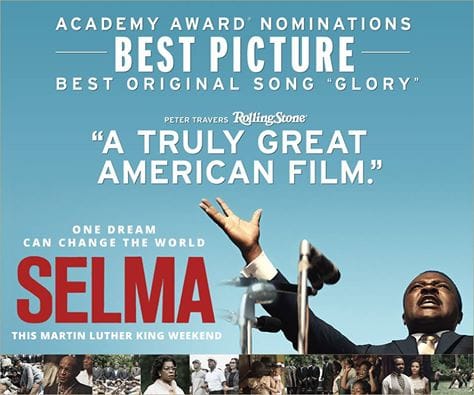
Why Selma Might Be The Movie for the Moment in Secondary ELA Classrooms
I remember 2020-2021 vividly as a re-awakening about my racial and cultural identity. For me personally, I grew up in a staunchly mixed-race household, torn and tousled between the white world of my father's family and the Vietnamese world of my refugee mother's. My Vietnamese identity was a somewhat misunderstood ,but also huge presence in my adolescence, and in my life, up until my mother's unexpected death in 2009. After she passed, since she was the matriarch of not only my nuclear family, but also her extended family, all of the traditions and time that she spent holding me, my cousins, and her brothers and sisters closely together slowly started to dissipate.
Ten years later, from George Floyd's murder, to the Capitol Attacks, to the Atlanta Spa Shootings, I just distinctly remember that time period teaching in a predominantly white teaching department, in a somewhat diverse school that still had a predominantly white population, that my "Asian-ness" bubbled to the forefront.
I remember the confusion and frustration at trying to talk with students about January 6th, when we adults were still processing. Back then, I offered choices for students to process / show up in class:
- the option to look through current events articles together
- the option to journal and reflect
- the option to sit with me and ask questions together
- the option to proceed with our scheduled class lesson
Students did what they were comfortable with that day. It still felt messy and worrisome.
Why Selma is a great movie to teach in 2026
Now, five years later, ICE 's occupation of Minnesota, the murder of Alex Pretti, the public responses to his murder, and the contrasting response from the administration – it feels quite similar to how it did on January 6th, 2021.
But for me, it also feels quite different. I no longer feel as uncomfortable, anxious, and unsure about how I'd like to proceed with students.
I still think choices are a great option, especially if you have a diverse classroom.
We went on to teach Do The Right Thing in following years, and while that film is heavy, yet powerful, and wonderful to work with - it can also be re-traumatizing. For students that see the truth and can sit with the discomfort, a film like Do The Right Thing, which feels as if it could've been made today even though it was made in 1989, just reinforces why it's important to teach the truth and complete history.
But seeing all of the peaceful community actions in Minnesota, and the way Minnesotans are continuing to come together to protect those targeted by ICE, this year I'm leaning into the power of film to offer historical events in proximity to what's going on, but somewhat far enough removed that it might be easier to discuss and process.
Enter Selma, directed by Ava DuVernay, rated PG-13, and released in 2014.
Selma illustrates the events, planning, and struggles Martin Luther King Jr., his organizers, and President Lyndon B. Johnson faced leading up to the marches from Selma to Montgomery, Alabama. It starts with the murder of four young Black girls at a Baptist Church (16th Street Baptist Church Bombing), goes through the murder of Jimmie Lee Jackson, as well as Reverend James Reeb, and illuminates John Lewis's march, as well as the march from Selma to Montgomery.
While these murders are, well, murder, and there is police brutality towards peaceful protesters, DuVernay utilizes film as a medium to illustrate this brutality without being graphically violent towards the audience. So, it's an accessible depiction of historical events for students. It's also rich for analysis (How does she illustrate these traumatic moments with grace? How does she humanize MLK Jr.? How does she illustrate the collective nature of collective action?).
The other reason Selma is a great film for the moment, is because it helps tell the history of a movement that took time to organize and develop, but came out with success (securing the Voting Rights Act of 1965).
The film honors history, doesn't sugarcoat, doesn't shy away, but depicts with grace. It humanizes MLK Jr., encourages students to consider the tension between the individual ego/leadership and community collaboration, and also gives them an opportunity to analyze how a work showcases different types of violence – and to consider...
- Who are the agitators?
- Who holds the power?
- Who's really causing violence? What kind?
- How do we create change with individuals, systems, and organizations who are willing to be violent and challenge the limits of the law?
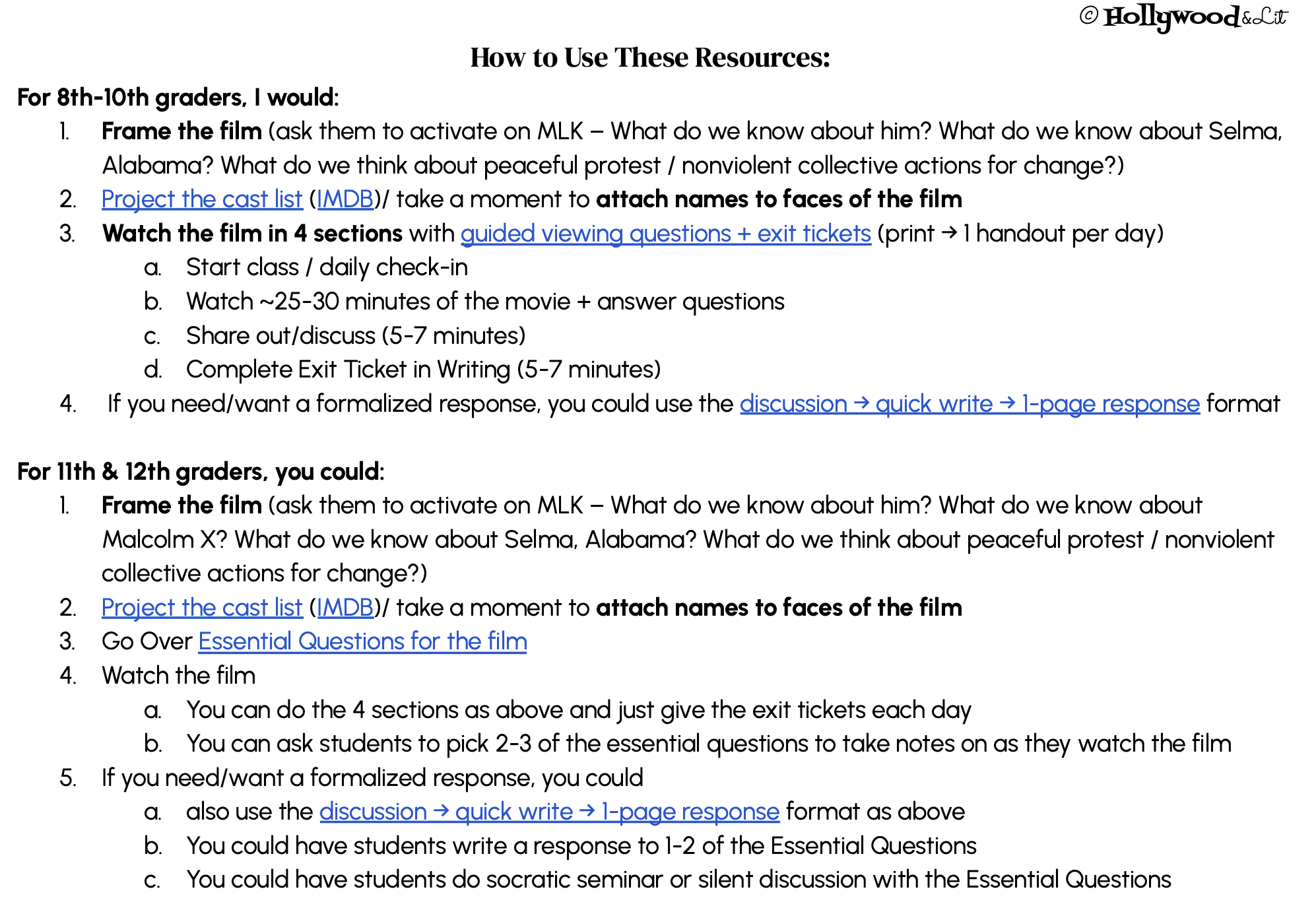
If you'd like to teach Selma, or even just watch it with your students, I've put together a free resource for secondary ELA teachers to use. These are resources that you can adapt to your style and students needs, and there are viewing questions and some writing prompts that are ready to go. You can download them below for free when you subscribe to my newsletter / become a free member, and of course these resources are also linked in The Planning Room Library.
If you have any questions, or want to chat lesson ideas, or challenges, you can comment on this post, message me on TikTok - connect how it's convenient for you.
Take care of yourself, so you can show up where you need to.
❤️🔥 Cara
File will appear below in place of the pink "this post is for subscribers only" box when you're logged in to hollywoodandlit.com.